How to Keep a Chicken Pie's Base Crisp for a Picnic
Hypothesis
Most soggy picnic pies are made soggy by their packaging, not by time. Trapped steam and condensation, more than the filling itself, should be the main culprit.
Kit
- Personal chicken pies, freshly baked or freshly reheated
- Wire cooling rack
- Baking paper or greaseproof paper
- Paper bags
- Airtight plastic lunchbox
- A second lunchbox with its lid cracked open, or a vented container
- Cling film
- Cooler bag and ice pack
Method
- We packed one warm pie straight into a sealed plastic lunchbox, the way it happens on a rushed morning.
- We cooled the other pies on a wire rack, uncovered, until they were cold right through, then chilled them, keeping their total time out of the fridge under 2 hours.
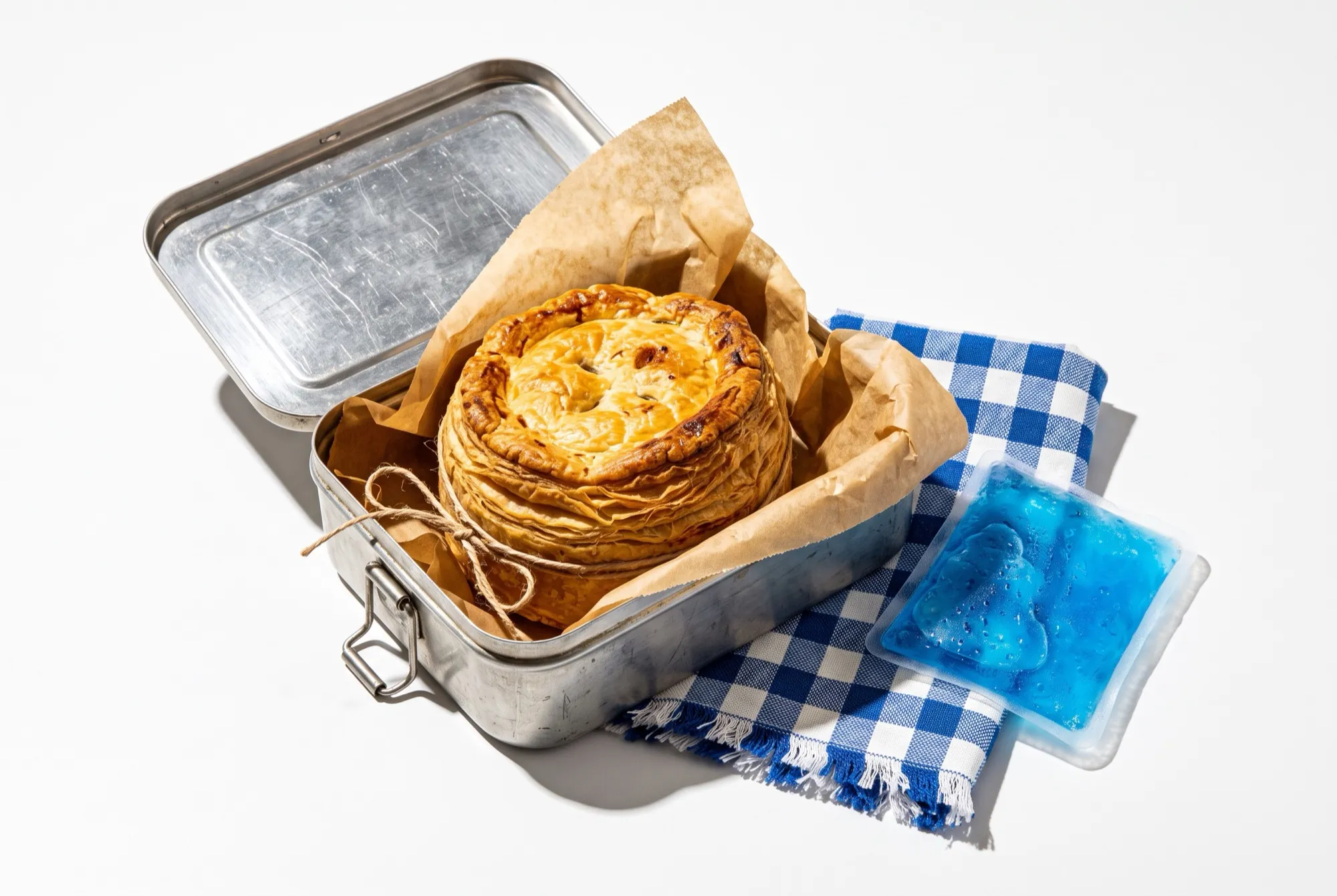
- We wrapped one cooled pie in cling film, one in baking paper inside a paper bag, and set one on baking paper in a box with the lid cracked open.
- Every pack travelled in a cooler bag with an ice pack for a morning, then came out into warm, humid outdoor air at lunchtime.
- We unwrapped each pie and checked the base, the lid and the inside of the wrapping for moisture.
What happened
Warm pie, sealed box
The box lid fogged up within minutes and was dripping by lunch. The base was soft and damp. The pie steamed itself.
Cooled pie, cling film
Better, but the film held a faint layer of moisture against the pastry and the lid lost its snap.
Cooled pie, paper and paper bag
Our best base. The paper took up what little moisture there was and the pastry stayed dry to the touch.
Cooled pie, vented box
Nearly as good as paper, and much better at surviving being squashed at the bottom of a tote bag.
Out of the cooler bag
A cold pie unwrapped early in humid air picked up a faint dew on its surface. Unwrapping just before eating kept that to a minimum.
Observations are qualitative: what a cook can see, hear and taste. We do not publish thermometer readings or scores we cannot stand behind. Your oven will differ, so run it yourself.
Verdict
Cool it, paper it
Our opinion: In our opinion the biggest win is patience: a fully cooled pie in paper or a vented box beats any clever gadget. If you want a hot pie at lunch, reheat it at the office rather than packing it hot.
Chicken pie is the perfect picnic food on paper. Self-contained, no cutlery, sturdy enough for a backpack. Then you open the lunchbox at East Coast Park and find a pale, damp pie sitting in a little pool of its own regret. We wanted to know who the real villain was, and the answer turned out to be the box.
Why does a warm pie go soggy in a lunchbox?
A warm pie is still breathing out steam. The filling holds a lot of water, and as long as the pie is warmer than the air around it, some of that water leaves as vapour. On a cooling rack, the vapour drifts away. In a sealed box, it has nowhere to go.
The air in a small box fills up with moisture quickly. The plastic lid is cooler than the pie, so the vapour condenses on it as droplets. Those droplets drip back down. The base, meanwhile, is pressed against a flat surface where steam collects underneath. By lunch, the pastry has reabsorbed the water the baker worked hard to drive out. The pie has effectively been steamed in its own container.
That is why cooling completely matters more than anything else. A cold pie has stopped releasing steam, so there is nothing to condense.
What does Singapore humidity do to a cold pie?
Here is the twist we did not expect. Even a perfectly packed cold pie can pick up moisture if you unwrap it too early. Singapore air is very humid, and anything colder than the dew point of that air collects condensation on its surface. It is the same reason a glass of kopi peng sweats on the table.
A pie fresh from a cooler bag is colder than the dew point of a typical Singapore afternoon. Unwrap it and leave it sitting, and a fine film of dew forms on the lid. The fix is simple: keep the pie wrapped until the moment you eat it.
Paper, cling film or a box?
| Packing | What it does to moisture | Protection from squashing | Our take |
|---|---|---|---|
| Sealed plastic box, warm pie | Traps steam, which condenses and drips back | Good | The soggy-base factory |
| Cling film, cooled pie | Holds a thin film of moisture against the pastry | Poor | Fine for the fridge, not for crisp pastry |
| Baking paper plus paper bag | Absorbs and lets moisture escape | Poor | Best base, but pack it on top |
| Vented box with baking paper | Lets moisture escape, paper wicks the rest | Good | Best all-rounder for a tote bag |
If you only change one thing, swap cling film for baking paper. Paper breathes. Plastic does not. More packing ideas live in our chicken pie lunchbox tips.
How long can a chicken pie sit out at a picnic?
This is the part that is not up for opinion. General food-safety guidance is that cooked food should not sit at room temperature for more than 2 hours. The food-safety danger zone runs from about 5C to 60C, which is where bacteria multiply fastest. The US food-safety agency shortens the limit to 1 hour when the air is above about 32C, and plenty of Singapore afternoons in the sun get there.
Our practical rules for a Singapore picnic:
- Keep the pie chilled until you leave home, then carry it in a cooler bag with an ice pack.
- Start the clock when the pie leaves the cooler bag, and eat within 2 hours. In direct sun, aim for 1.
- Do not carry leftovers home for later. A pie that has been sitting out at a picnic is done.
- Never pack a pie warm and leave it to cool slowly in a closed bag. That is a long, slow trip through the danger zone, as well as a soggy one.
Buying pies on the way to the picnic instead? The same clock applies from the moment you collect them, and donpieshop.com’s guide to transporting pies in Singapore heat has a checklist for the journey.
The maker of the Don chicken pie advises eating within 4 hours of purchase for best results. That is the maker’s quality window for a freshly bought pie, not permission to leave it in the sun. If you are not eating soon, chill it. Our post on how long chicken pie lasts in the fridge has the full storage timeline.
Should you eat a picnic pie cold or reheat it at the office?
A chicken pie that was properly chilled and kept cold is fine to eat cold, and a cold pie on a hot day has its fans in our crew. The pastry is firmer and the gravy is set, which makes it tidier to eat with your hands.
For an office lunch where you want it hot, pack the pie cold and reheat it at work until piping hot, 75C at the centre. Most office pantries have only a microwave, so follow our microwave chicken pie rescue: short bursts on medium, then a few minutes in a toaster oven or air fryer if there is one.
How to reproduce this at home
- Cool one pie fully on a rack, then chill it. Pack another while still warm.
- Wrap the cooled pie in baking paper and pack it in a box with the lid cracked or a vented container. Seal the warm pie in a plastic box.
- Put both in a cooler bag with an ice pack for a morning.
- Open both at lunch and compare the base, the lid and the inside of each box.
If you are picking pies up on the way to the park, check where to buy a Don chicken pie for the current outlets, then let them cool before they go into any box.
What would we change next time?
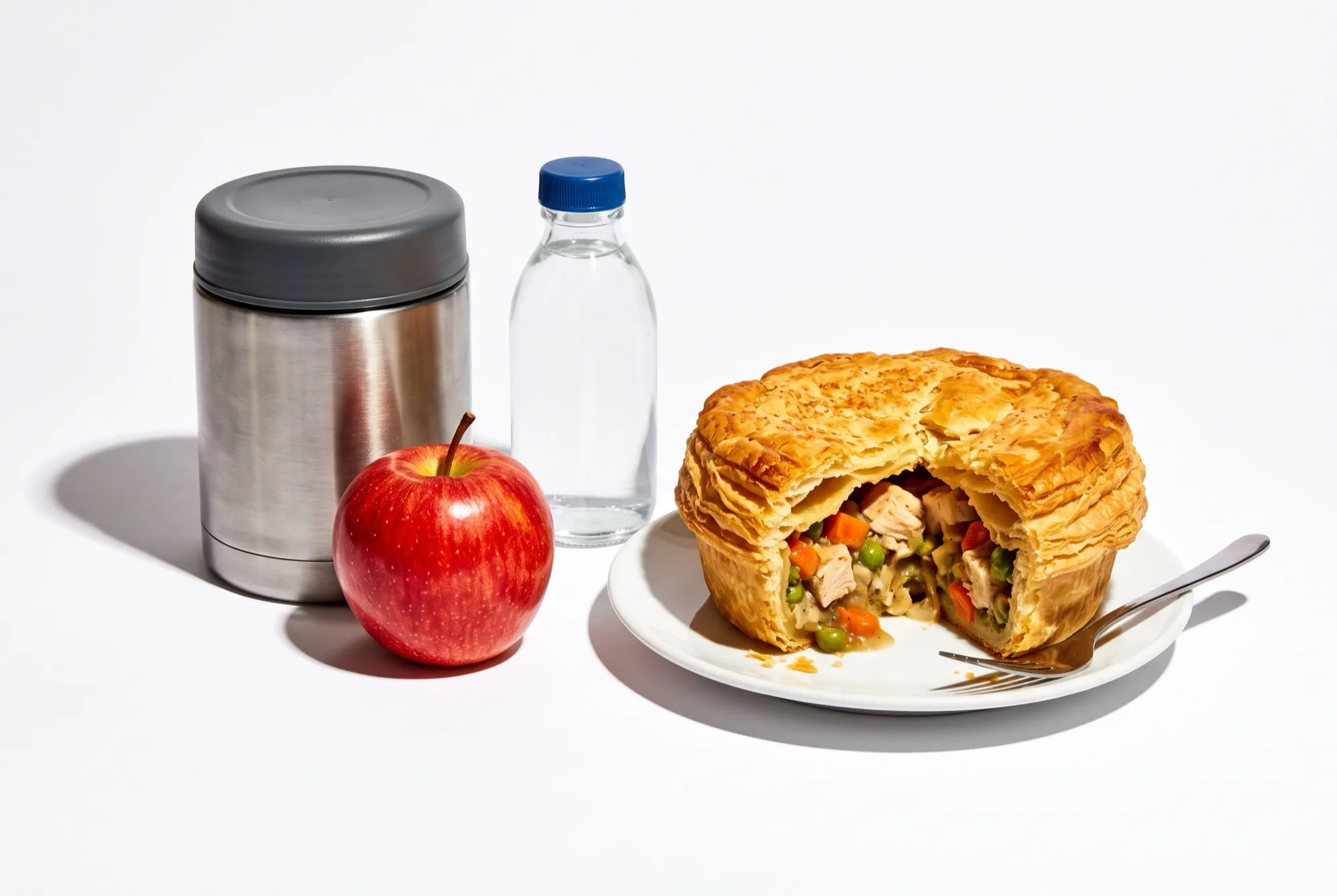
- Test a food flask. Some people try to keep a pie hot in an insulated food jar. We suspect it will not stay above 60C for long and will steam the pastry, but it deserves a proper go.
- Try whole-pie slices for a potluck. Cut slices expose the filling, which changes the moisture story completely.
- Compare tins and plastic. A tin lunchbox feels more breathable, but a sealed tin traps steam just as well. A vented tin might be the dream.
EXP-05 is one of our chicken pie experiments, run on the Don chicken pie. For the settings without the story, use the chicken pie reheat calculator; for the pie itself, start with the Don chicken pie guide.