Air Fryer Chicken Pie: Two Stages Beat One Blast
Hypothesis
A single blast at 200C will brown the lid before the centre warms, and a long low setting will heat through without crisping. Splitting the job into a gentle stage and a hot stage, as the maker suggests, should do both.
Kit
- Chilled personal chicken pies from the same batch
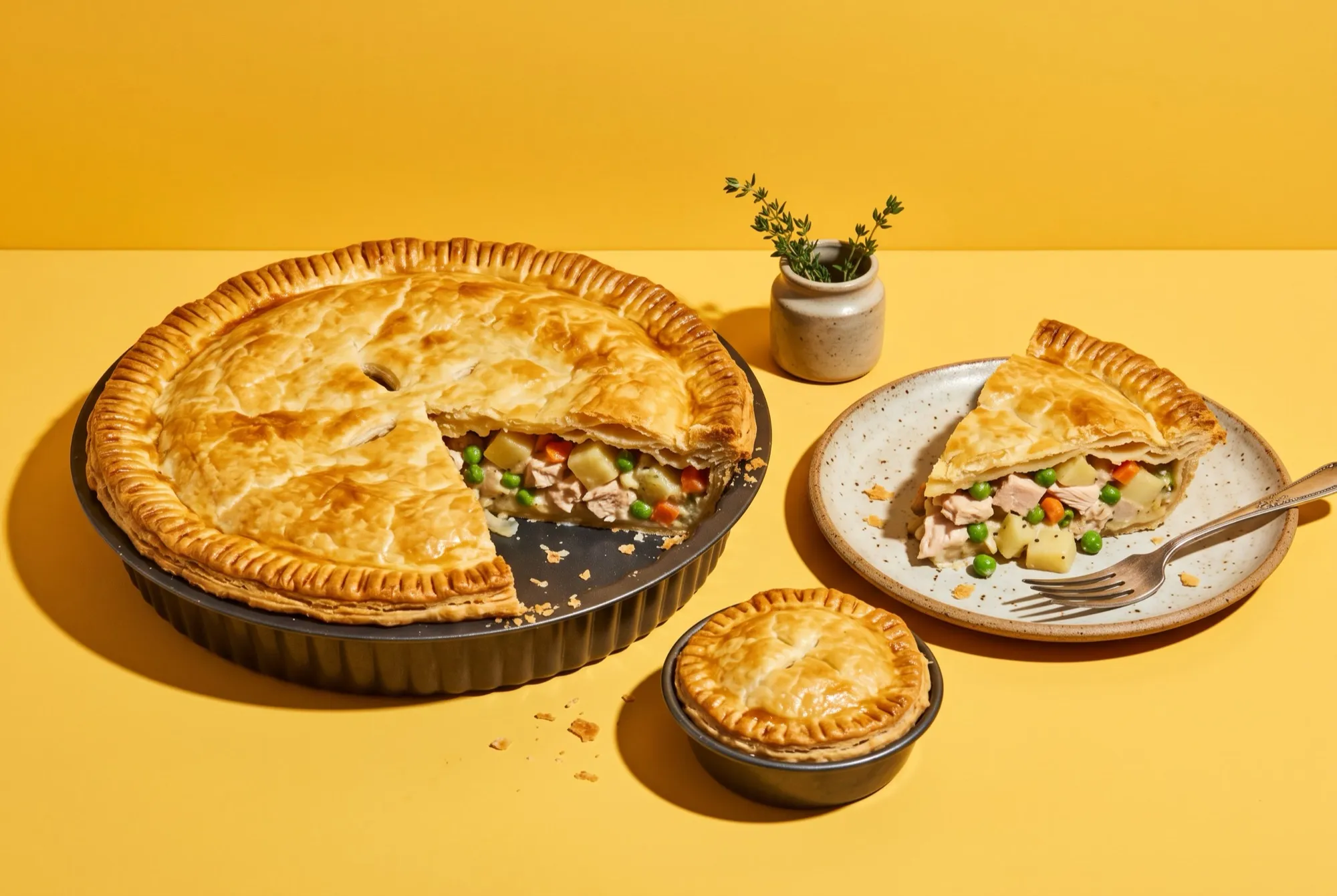
- A whole chicken pie, for the size check
- Basket-style air fryer
- Perforated metal rack or trivet that fits inside the basket
- Foil, cut into a narrow strip for a collar
- Probe thermometer
- Tongs and a thin spatula
Method
- We preheated the air fryer for 3 minutes before every run so each pie went into hot, moving air.
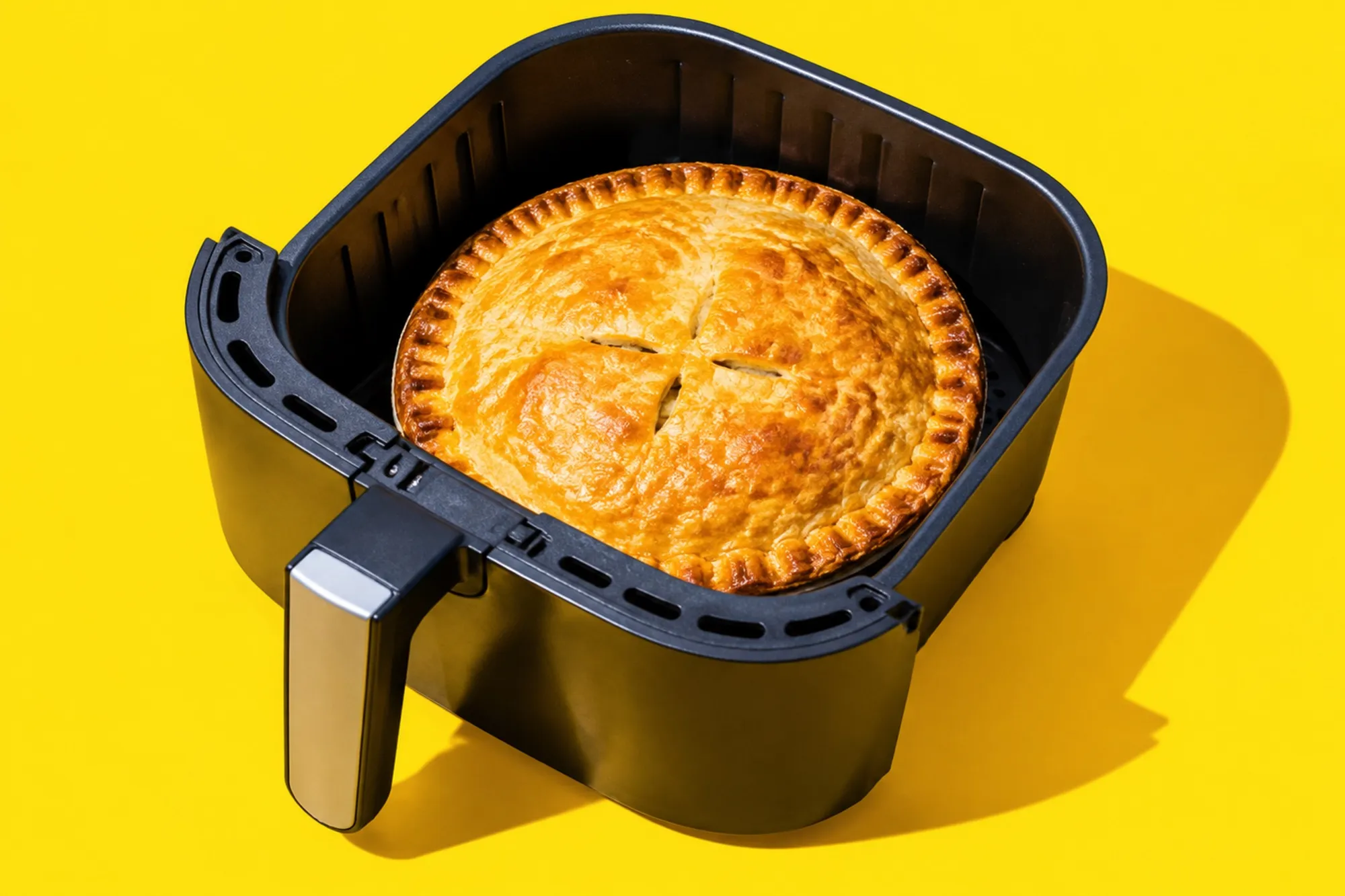
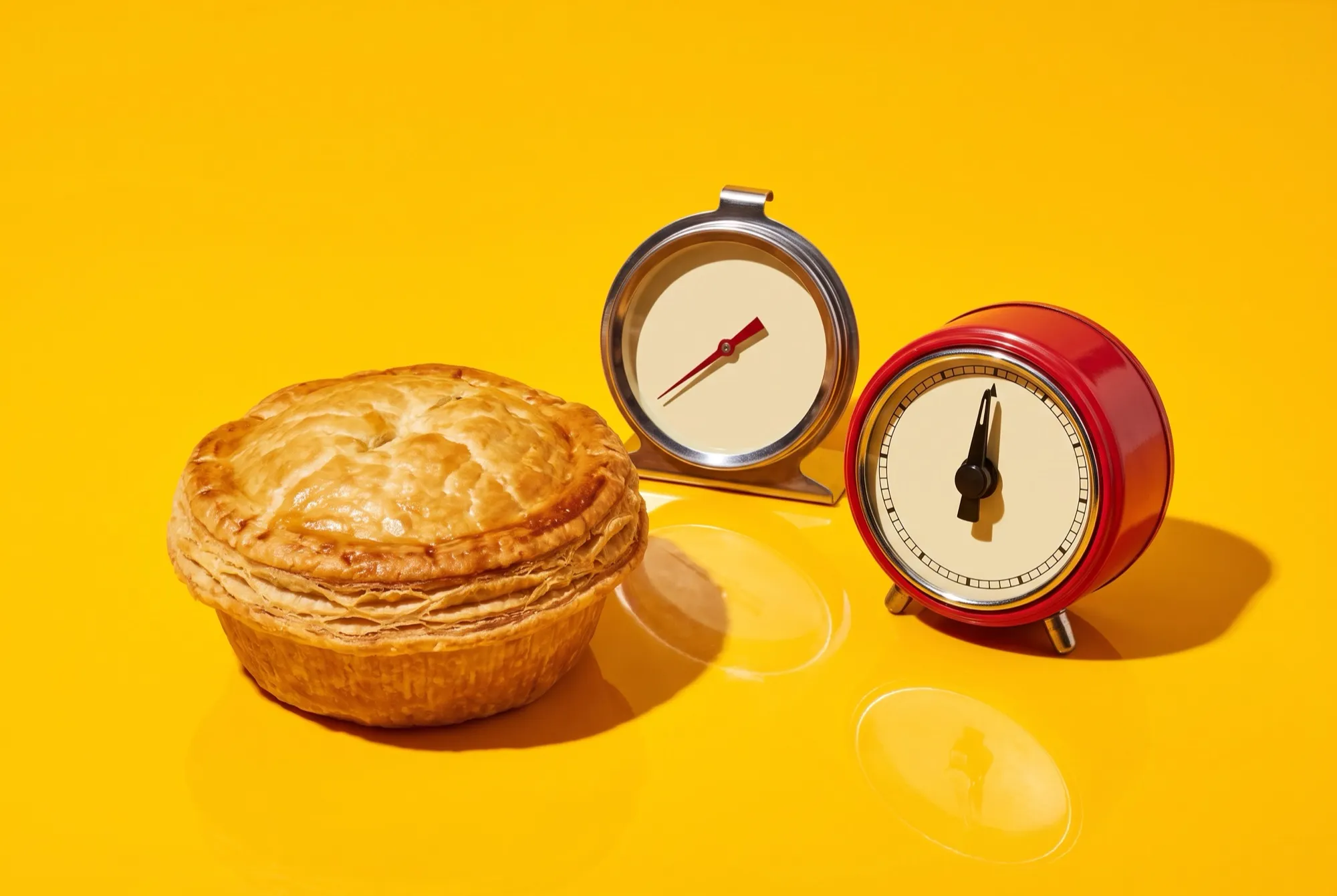
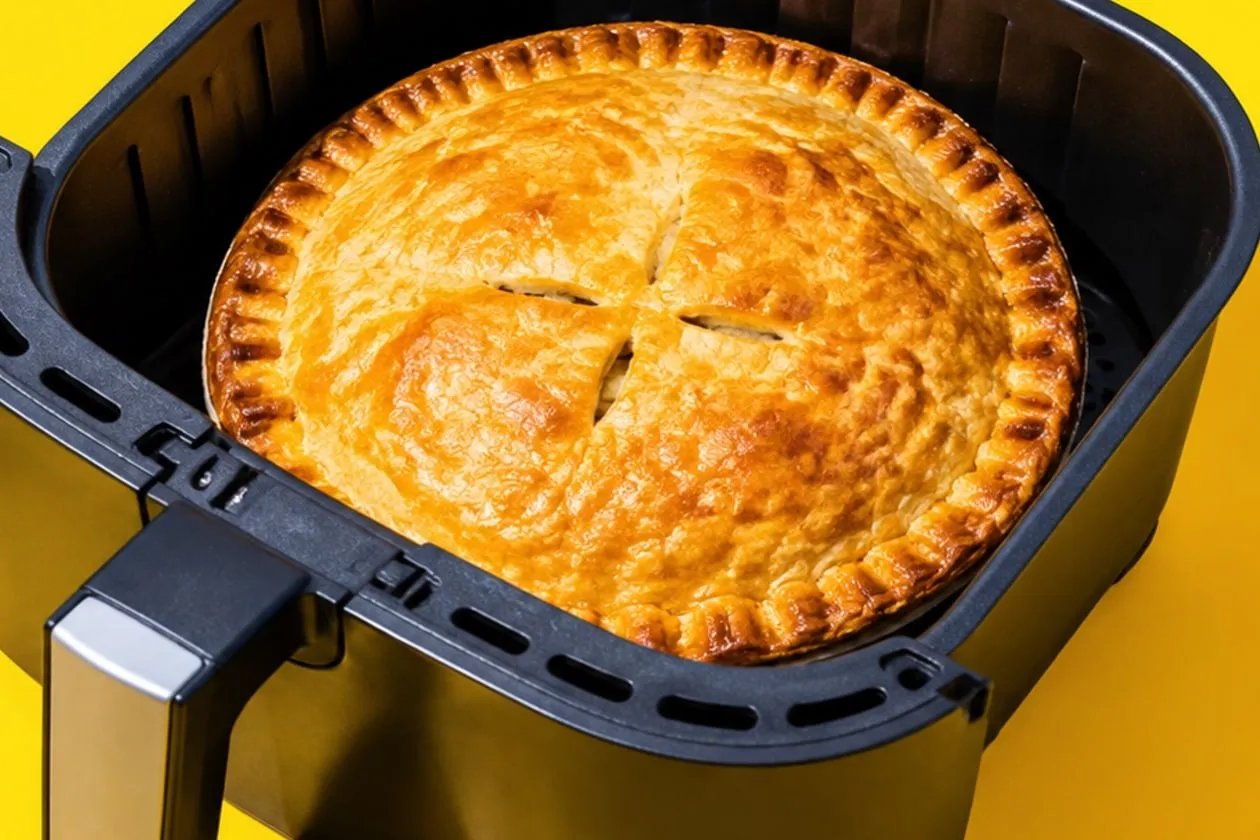
- Two-stage: following the maker's guidance, we heated a pie at 150C for 5 minutes, then 200C for 5 minutes, then probed the centre and added a few minutes at 150C until it reached 75C.
- Single hot blast: we heated a second pie at 200C straight through, checking every 2 minutes and stopping when the centre was piping hot.
- Low and slow: we heated a third pie at 140C for 12-15 minutes, until the centre reached 75C.
- Foil collar: we repeated the two-stage run with a narrow strip of foil folded over the crimped edge and pinched tight so the fan could not lift it.
- Basket versus rack: we ran the two-stage setting once with the pie sitting directly on the basket floor and once raised on a perforated rack.
- Whole pie: we tried a whole pie in the basket to see whether air could still move around the sides.
What happened
Two-stage
Our best air-fryer pie. Centre hot, lid crisp and evenly golden, crimp browned but not dark. Straight from the fridge it needed a little extra time at 150C, which was easy to add.
Single hot blast
Fast and loud. The lid and crimp darkened quickly while the middle lagged behind, and the egg and potato at the centre were the last things to warm.
Low and slow
Even heat and no scorching, but the lid stayed pale and the pastry felt dry rather than crisp. Perfectly edible, nothing to brag about.
Foil collar
The crimp stayed lighter and the lid browned more evenly. Worth the fiddle for any pie with a thick crimped edge.
Basket versus rack
Raised on a rack, the base came out drier and crisper. Flat on the basket floor, the base was softer where steam had nowhere to go.
Whole pie
A whole pie fills a standard basket edge to edge and blocks the airflow around it. The middle stays cool long after the top is done.
Observations are qualitative: what a cook can see, hear and taste. We do not publish thermometer readings or scores we cannot stand behind. Your oven will differ, so run it yourself.
Verdict
Two stages, every time
Our opinion: We think the maker's two-stage setting is the one to beat. Add a foil collar if your crimp browns fast, lift the pie on a rack, and save whole pies for the oven.
The air fryer is the appliance most of our readers actually own, and the one that causes the most arguments. Some people crank it to maximum and hope. Some people treat it like a gentle oven. The maker of the Don chicken pie publishes a very specific two-stage setting, which is exactly the kind of instruction a bunch of pie nerds cannot resist poking at.
Why does an air fryer brown pastry so fast?
An air fryer is a small convection oven with a very enthusiastic fan. Around any food sits a thin layer of cooler, damp air that acts like a duvet. Still air in a normal oven leaves that duvet in place. The air fryer’s fan rips it away, so hot air touches the pastry directly and heat moves in far faster than the dial number suggests.
That is great news for the lid. Pastry is thin, fairly dry and full of fat and starch, so it heats up, loses its surface moisture and starts browning almost at once. The browning is the Maillard reaction plus a little caramelisation, the same chemistry that makes toast taste like toast.
The bad news is the centre. Heat reaches the middle of the filling only by conduction, creeping from one chunk of chicken to the next piece of potato. Conduction does not care about your fan. Turn the dial up and the surface speeds up far more than the middle does, which is the whole problem with the single hot blast.
Why do two stages beat one?
The two-stage setting is the pie version of a reverse sear on a steak. The gentle first stage lets heat soak inward while the surface stays below serious browning temperature. Once the inside has a head start, the hot second stage crisps the outside quickly, before the edges have time to burn.
Low and slow fails for the opposite reason. The centre gets hot, but the surface never gets hot and dry enough for long enough to crisp. You end up with warm, pale pastry that is dry rather than flaky.
How long should you air-fry a chicken pie?
The honest answer: it depends on where the pie is starting from and how big your basket is. Here is how we would set it, with the maker’s guidance labelled.
| Starting point | Setting | Source | Notes |
|---|---|---|---|
| Personal pie, bought the same day | 150C for 5 min, then 200C for 5 min | The maker’s guidance | Check the centre is piping hot before eating |
| Personal pie, chilled | 150C for 5 min, then 200C for 5 min, plus extra minutes at 150C if needed | Maker’s setting, our extension | Add time at the low stage, not the high one |
| Personal pie, frozen | Thaw overnight in the fridge first, then as chilled | Our suggestion | See our freezing experiment for reheating from frozen |
| Whole pie | Use the oven instead | Our suggestion | Most baskets cannot circulate air around a whole pie |
Every air fryer runs differently. Basket size, fan strength and how accurate the thermostat is all vary between models, so treat these times as a starting range and let the probe thermometer have the final word: 75C at the centre.
Does a foil collar actually help?
Yes, for pies with a chunky crimp. The crimped edge is thin and exposed on two sides at once, so it browns first. A narrow strip of foil folded over the edge reflects heat away from it while the rest of the lid catches up.
Air fryer safety matters here. Foil that is loose can be lifted by the fan and blown into the heating element. Pinch the collar tight around the rim, keep it small, and never let foil touch the element. The same goes for paper liners: never preheat an air fryer with an empty paper liner inside, because the fan can lift it into the element.
Basket floor or rack?
A pie sitting flat on the basket floor traps a little pocket of steam underneath. That steam has nowhere to go, so the base softens while the lid crisps. Lifting the pie onto a perforated rack lets hot air flow under the base and carries the steam away. If you use a liner, choose a perforated one. A solid liner turns your air fryer into a very small steamer. Once the pie is out, leave it on the rack for a minute or two before you cut in; the bakers explain why a pie should rest before you cut it, and the same logic applies to a reheat.
Can you air-fry a whole chicken pie?
In most basket air fryers, not well. A whole pie that feeds 4-6 people is wide and deep. Wedged edge to edge in the basket, the fan cannot get air down the sides, and the deep centre needs far more time than the lid can survive. A dual-zone or oven-style air fryer with more room might cope with a foil cover and long low stage, but a conventional oven is simply the better tool. If you are choosing what to buy, our guide to personal versus whole Don chicken pies covers which size suits which kitchen.
For context on how the air fryer stacks up against the oven, toaster oven and microwave, see the five-way reheating experiment.
How to reproduce this at home
- Preheat the air fryer for a few minutes so the pie meets hot air from the start.
- Put the pie on a rack or perforated liner in the basket.
- If the crimp is thick, fold a tight foil collar over it.
- Run 150C for 5 minutes, then 200C for 5 minutes.
- Probe the centre. If it is under 75C, drop back to 150C and give it a few more minutes.
- Rest the pie for a minute or two. The filling is far hotter than the lid suggests.
Our reheat calculator has the same settings for other appliances and starting points.
What would we change next time?
- Test more machines. One crew member’s compact basket and another’s big oven-style air fryer probably need different times. A second machine would tell us how far the maker’s setting travels.
- Try a frozen pie. Reheating from frozen in an air fryer is popular and risky, because the surface can finish long before the centre thaws. That needs its own careful run.
- Flip the order. Out of pure curiosity, we want to try the hot stage first and the gentle stage second, to prove to the sceptics in the group that the order matters.
EXP-02 is one of our chicken pie experiments, run on the Don chicken pie. For the settings without the story, use the chicken pie reheat calculator; for the pie itself, start with the Don chicken pie guide.